
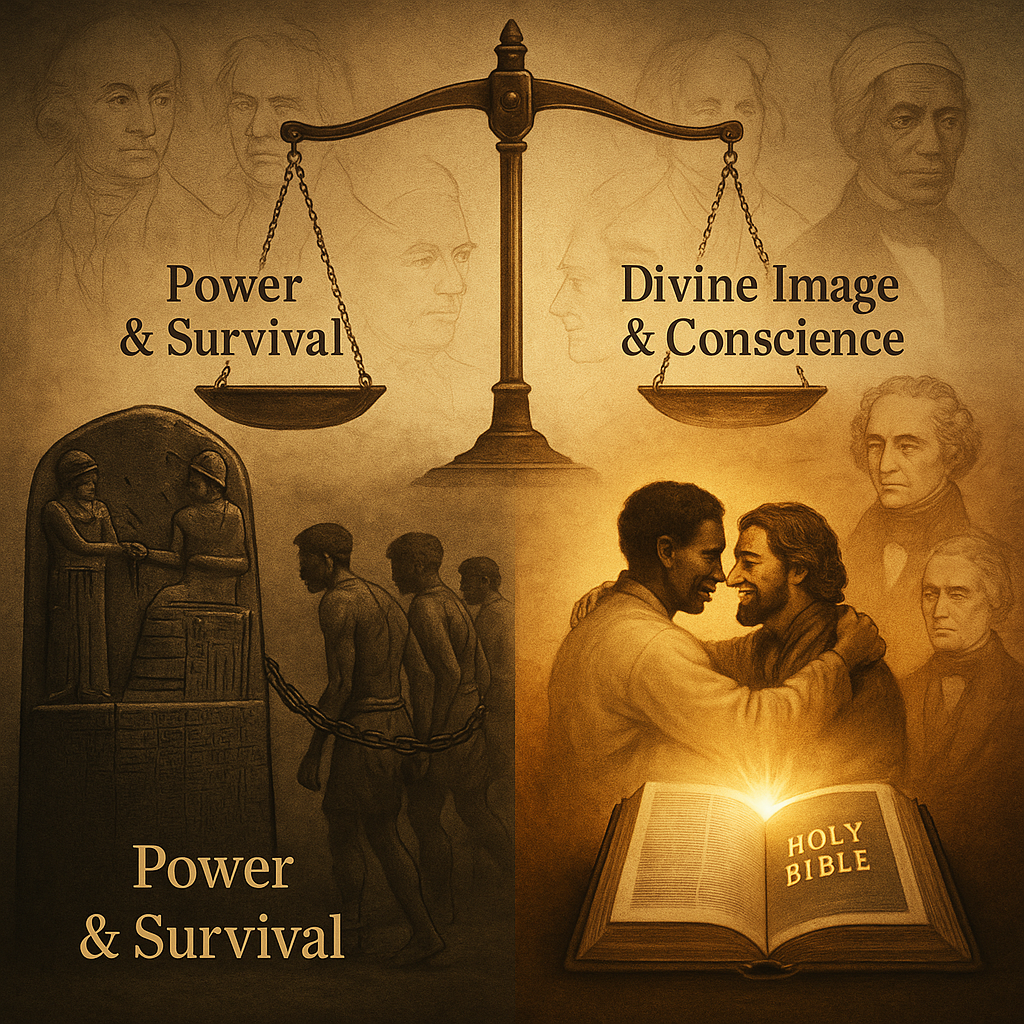
“If the Bible talks about slavery, how can it be trusted as a moral guide?” This objection often sits at the heart of modern skepticism toward Scripture. In a culture committed to justice and human rights, slavery is rightly seen as one of history’s most horrific institutions. But does the Bible promote it? Or did it actually plant the seeds that led to its abolition? This article explores that tension. While the Bible acknowledged slavery in ancient times, it laid the moral foundation for the only worldview that ultimately dismantled it.
What Is Slavery? A Historical Baseline
Before weighing the biblical record, we must define terms. Slavery has existed in nearly every society. Its most brutal form, chattel slavery, treats people as property to be bought, sold, inherited, and exploited for life. It is racialized, hereditary, and dehumanizing. Other forms include indentured servitude (working off debts), war captives, and domestic servitude.
Across all these types, one thing is clear: when morality is shaped by power, economy, or survival, slavery becomes the human norm. The real question is not whether the Bible tolerated slavery, but what worldview finally dismantled it—and why.
Slavery in Ancient Civilizations
To appreciate the Bible’s moral distinctiveness, consider a few examples from the ancient world:
- Mesopotamia (Code of Hammurabi): Slaves were beaten, branded, and had no legal rights; they were property.
- Egypt: Used forced labor on a massive scale for construction, including foreigners and captives.
- Greece (Athens): Up to one-third of the population were slaves, with no political rights; philosophers like Plato accepted this structure.
- Rome: Slaves were often prisoners of war or born into slavery; they could be crucified, mutilated, or forced to fight in arenas.
These cultures saw slavery as normal and necessary. Even their leading philosophers rarely questioned it.
Slavery in Biblical Times
Old Testament Context
In the ancient Near East, slavery was a social reality. The Old Testament didn’t erase it but introduced regulations that humanized and limited it.
- Hebrew slaves were to be released after six years (Ex. 21:2)
- Owners were punished if they injured or killed a slave (Ex. 21:20–27)
- Slaves rested on the Sabbath (Ex. 20:10)
- Jubilee laws required land and people to be restored (Lev. 25)
Slavery in Israel functioned more like indentured servitude or poverty relief, not chattel slavery. That said, difficult texts remain—such as Deut. 21:10–14, where women captives from war may be taken as wives, and Ex. 21:20–21, which deals with discipline of slaves. These passages require contextual understanding but demonstrate God working within a broken system, not endorsing it.
New Testament Context
In the Roman world, slavery was deeply entrenched. Yet Christianity introduced a quiet revolution. Paul writes:
- “There is neither slave nor free… for you are all one in Christ Jesus.” (Gal. 3:28)
- “Masters, treat your slaves justly and fairly.” (Col. 4:1)
- Paul appeals to Philemon to receive his escaped slave Onesimus “no longer as a slave but more than a slave—a beloved brother.” (Philemon 1)
The New Testament doesn’t call for political overthrow, but it redefines the relationship. Christians were to see slaves as equal image-bearers and spiritual family. In time, these seeds would fracture slavery from within.
The Rise of Chattel Slavery and the Moral Crisis
With the transatlantic slave trade, a new horror emerged—race-based, lifelong, hereditary slavery. Slaveowners used the Bible to justify their actions, twisting verses like “Slaves, obey your earthly masters” (Eph. 6:5). This weaponized Scripture. But simultaneously, Christians also began using the Bible to destroy slavery.
The Seeds of Abolition: Bible vs. Enlightenment
A. The Biblical Case
- Human dignity: all people made in God’s image (Gen. 1:27)
- Liberation and justice as central biblical themes (Exodus, prophets)
- Reformation restored the Bible to the people, emphasizing conscience and personal worth
- Evangelical awakenings awakened moral outrage and led to activism
Primary texts support this arc:
- Leviticus 25 promotes year-of-Jubilee release for Israelite servants.
- 1 Timothy 1:10 includes enslavers among the lawless.
- Paul teaches that love is the fulfillment of the law (Rom. 13:10), which undermines oppression.
B. The Enlightenment Case
- Emphasis on liberty, autonomy, and natural rights
- Thinkers like Locke and Rousseau reshaped legal frameworks
- However, Enlightenment leaders were often silent or inconsistent on slavery:
- John Locke invested in the Royal African Company
- Rousseau spoke of freedom but excluded colonial realities
- Voltaire owned shares in slave-trading ventures
Some Enlightenment thinkers, such as Jeremy Bentham, critiqued slavery on utilitarian grounds, arguing that suffering is universal. But these views rarely translated into widespread movements without religious conviction.
C. Who Actually Led the Abolition Movement?
- Quakers, Wilberforce, Frederick Douglass, Sojourner Truth—all deeply Christian
- British Parliament abolished slavery in large part due to Christian activism
- In America, revivalists and church networks formed the backbone of the Underground Railroad
Common Objection: “The Bible Never Condemns Slavery”
It’s true that the Bible doesn’t say, “Thou shalt not own slaves.” But that’s not the whole story.
- Scripture’s silence is not endorsement—it’s subversion over time.
- Biblical ethics restrict and transform power dynamics from the inside.
- Jesus, Paul, and the prophets aimed at the heart of injustice by teaching love, mercy, and brotherhood.
- Christian history shows that when people truly applied Scripture, they couldn’t remain slaveowners.
Evaluating the Two Worldviews
| Criterion | Biblical Worldview | Enlightenment View |
|---|---|---|
| Historical Origin | Seeded the abolition movement | Refined legal language of liberty |
| Moral Foundation | Human dignity rooted in divine image | Empathy, reason, shifting cultural consensus |
| Activist Movement | Led by Bible-believing Christians | Few abolitionist philosophers |
| Coherence | Consistent moral arc from Genesis to Christ | No transcendent foundation |
| Global Impact | Transformed hearts and systems across continents | Worked best in elite, educated societies |
Final Verdict
The Bible did not invent slavery—humanity did. What makes the Bible unique is not its acknowledgment of slavery, but its slow, steady moral revolution against it. While Enlightenment ideals provided useful language for liberty, the fuel that drove abolition was faith—the belief that God made every human in His image and calls the strong to protect the weak.
Maybe the Bible isn’t the problem. Maybe it’s the foundation for the solution we’ve been searching for all along.
Recommended Reading:
- Rodney Stark, For the Glory of God
- David Brion Davis, The Problem of Slavery in Western Culture
- Thomas Sowell, Conquests and Cultures